Saving
Save $1,000 for emergencies by the end of March
A small buffer stops a flat tyre or a vet bill going on the credit card. It's the best first money goal.
First stepOpen a separate savings account and name it "Emergencies".
These financial goals examples are for everyday money: building a buffer, clearing a card, spending less on the things that leak and earning a bit more. A money goal works when it has an amount, a date and a step you can take this week, like a transfer on payday.
Each one is a SMART goal. Change the amounts to fit your pay, then work out the weekly step: the amount divided by the weeks you have. See Money goals in weekly steps for how. These are examples to adapt, not financial advice.
Saving goals are easier when the money moves on its own. Set up the transfer for payday, and the goal is mostly about not touching it.
6 examplesA small buffer stops a flat tyre or a vet bill going on the credit card. It's the best first money goal.
Once the first $1,000 is there, this is the bigger version. Work out your monthly costs first so the target is real.
A trip with a date is easy to save for, because you can see it getting closer.
A weekly amount is simpler to stick to than a big total. At the end of the year it's $2,600.
Money you weren't counting on is the easiest to save, because you never get used to spending it.
A big goal like this needs a weekly number. At this size, it's about $96 a week over two years.
Debt goals are about paying more than the minimum, on a date. Pick one debt to focus on at a time, and keep paying the minimum on the rest.
5 examplesOne card, one date. Seeing the balance go down each month is what keeps it going.
An extra repayment cuts the interest and the time. Check first that your loan allows it.
Small instalments are easy to lose track of. Clearing them all gives you a clean start.
Clearing one debt fast feels good, and rolling the payment into the next debt keeps the momentum.
You can't pay off a card while it's still filling up. Three months is long enough to change the habit.
Spending goals are about the money that leaks out without you deciding. Choose one area and put a number on it.
5 examplesA monthly limit is easier than "eat out less". Track it weekly so the end of the month isn't a surprise.
Unused subscriptions are money for nothing. Two is a quick win.
Lunches add up fast. Four days leaves one for a lunch out with friends.
A weekend with no spending shows how much of it was just habit, and it's often more fun than it sounds.
A short wait stops most impulse buys. If you still want it after two days, buy it.
Income goals are often overlooked, but earning a bit more can move a money goal faster than cutting back.
4 examplesClutter you don't need is cash you haven't collected. It clears space too.
A side income gives the savings goals something extra to work with.
A pay rise is worth more than most savings habits, and asking is fully in your control.
For a hobby business, a sales target turns weekends at markets into a plan.
Long-term goals are the slow ones. Give them a yearly number and a check-in date, so they don't drift.
5 examplesA small rise in what you put away is easy to forget about, and it adds up over years.
Adding up what you own and owe once a month shows whether things are going the right way.
Knowing more about money makes every other goal on this page easier to set well.
Small regular amounts become a real start for them, and it's a habit they can see.
A short regular talk keeps you on the same page and stops money turning into arguments.
"Save more" can't be tracked. "$1,000 by March" can.
Divide the amount by the weeks you have. If the number is too big, move the date, not the goal.
Put the extra money on one debt and pay the minimum on the rest.
A transfer that goes on payday works better than remembering.
A line about what the money is for keeps you going when the weekly step feels small.
Tick off each deposit or payment, so you can see the gap close.
Financial goals are plans for your money with an amount and a date: saving for something, paying off a debt, spending less in one area or earning more. They work best broken down into a weekly or payday step.
An emergency fund of $1,000 is the most common first goal, because it stops small surprises becoming new debt. After that, paying off the most expensive debt and saving for one thing you care about are good next steps.
Pick the amount and the date, then divide to get the weekly step. Check the step fits your pay, set up a transfer for payday, and track it each week. Money goals in weekly steps walks through it.
Many people build a small emergency fund first, then put extra money on their most expensive debt. What's right depends on your situation, so for big decisions talk to a qualified financial adviser.
No. These are examples to help you set and track your own goals. For decisions about investing, retirement or large debts, talk to a qualified adviser.
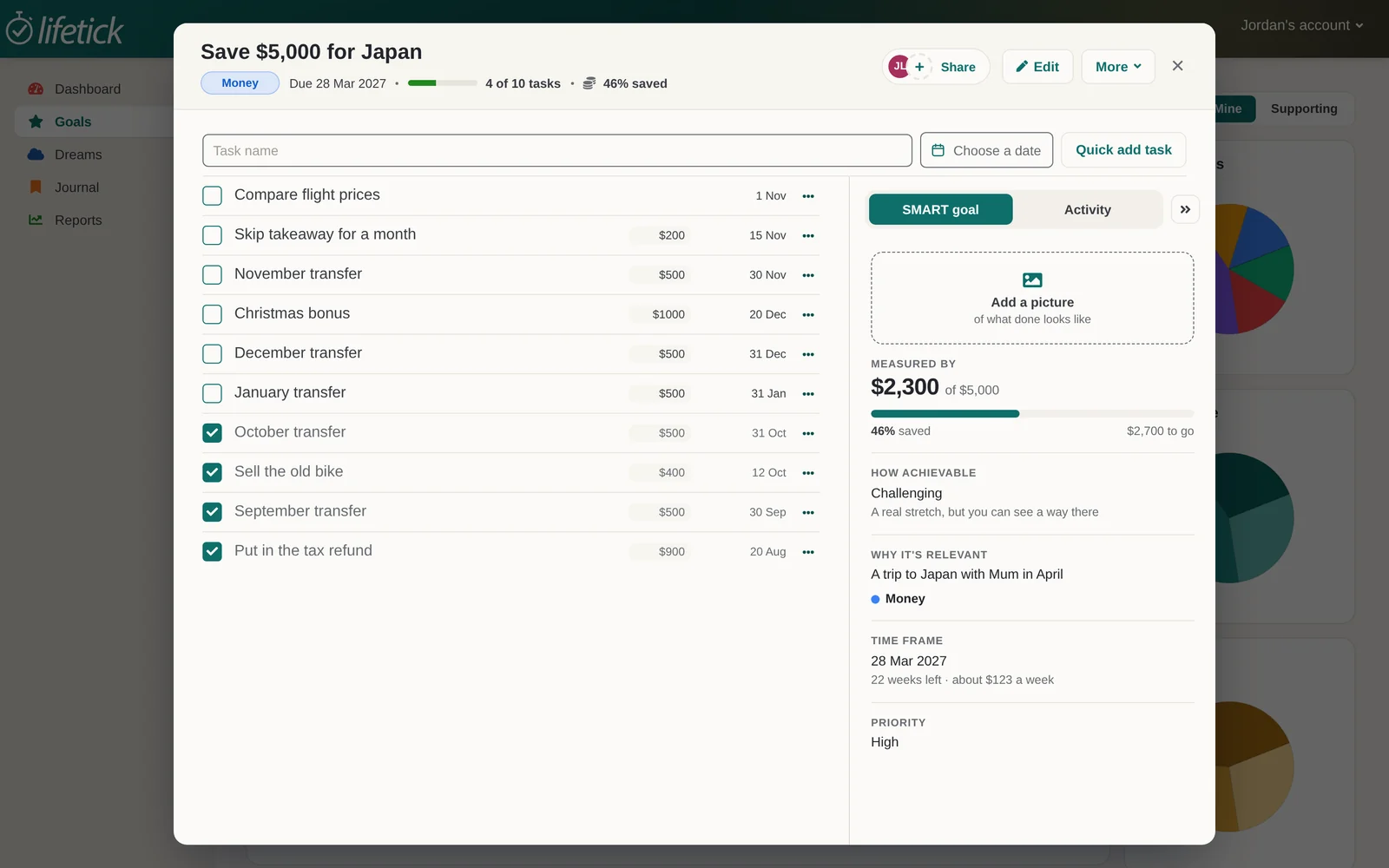
In Lifetick, a money goal measures progress in dollars. Choose save money, pay off debt or hit a sales target, enter the amount, and give each task its own amount, like a $96 weekly transfer. Tick it off and the goal shows how much you've reached and how much is left.
A Savings tracker charts what you put aside week by week. Money goals and trackers come with Premium. Lifetick doesn't connect to your bank: it's for the goal and the steps, not your budget. See Set a money goal and Create a tracker and log values.
For more on tracking savings and debt, see the money goal tracker and Lifetick for you.
Twenty team goal examples for sales, support, operations and small business owners, each with a number, a date and a first step to take this week.
For teamsTwenty performance goals examples for staff and managers, each with a number, a date and a first step, so reviews talk about progress, not opinions.
For teamsTwenty professional development goals examples for skills, study, leadership and career moves, each with a date and a first step for this week.
Lifetick is free on iPhone and the web, and five quick questions make it a SMART goal.
