Follow up every quote within two working days
Most lost quotes are never followed up, not turned down. This is fully in the salesperson's control, which makes it a good first goal.
These team goal examples are written for small teams. A team goal is only useful if someone owns it, it has a number and a date, and there is something to do about it this week. Most lists skip one of those, so you get "improve customer service" and nobody knows what to do on Monday.
Here are twenty, grouped by team type, each written so one person can own it and each a SMART goal. Copy one, change the numbers and give it a first step, or shape your own with the SMART goal generator.
Sales goals are the easiest to measure and the easiest to get wrong. Pair a result goal (wins, revenue) with an activity goal (calls, follow-ups) so people can still make progress in a slow month.
5 examplesMost lost quotes are never followed up, not turned down. This is fully in the salesperson's control, which makes it a good first goal.
Contract work is steadier than one-off jobs, so a small number is worth a lot.
A rate goal rewards better quotes, not just more of them. Measure it the same way every month.
Referrals close faster and cost nothing. Ten a month is about two a week, which fits in a busy schedule.
This one sounds like admin, but it is what makes the pipeline worth looking at. Check it each Friday in the weekly check-in.
Support goals work best when they mix speed with quality. A team chasing response times alone will close tickets that come straight back.
5 examplesA fast first reply calms most customers down, even before the problem is fixed.
A repeat contact is the same customer back about the same problem. Fewer of them means problems are being fixed the first time.
Every article that answers a common question is a ticket nobody has to write.
A goal to hold a good number is still a goal, and it makes slipping visible early.
Old tickets are usually stuck waiting on someone else. Clearing them often means a few awkward conversations.
Operations goals are about doing the same work faster, cheaper or with fewer mistakes. Pick the one that hurts customers most.
5 examplesCustomers often go with whoever answers first. Faster quotes help sales without anyone working harder.
On-time delivery is what customers remember. Count it the same way every week so the number means something.
If one person is sick or leaves, these are the jobs that stop. A one-page checklist for each is enough.
Write-offs are money that quietly disappears. A monthly count catches problems while they're still small.
Some goals are about a habit, not a number. Thirteen talks in thirteen weeks is easy to track and easy to see if it slips.
In a small business, the owner's goals are the team's goals. These work best when the owner sets one and each person picks a goal of their own that helps it along. Goal setting for small business owners covers how to choose them.
5 examplesA clear revenue goal gives everyone's other goals a reason. Use your own numbers, and make the jump big enough to need a change.
Cash in the bank matters more than sales on paper.
The second half of the goal is the important part. A hire who still needs help every hour after two months hasn't saved anyone time.
Reviews bring in new customers for free. The habit is simple: ask every customer when the job is done.
An owner goal that needs the whole team to work. It forces the handovers and checklists that make the business easier to run every week.
A team goal everyone owns is a goal nobody owns. Turn it into goals each person can own.
Without them, nobody knows when it's done.
Two or three goals a quarter per person is plenty. More than that and they all move slowly.
Ask which of your values each goal serves. It shows what the team is really spending its time on.
Every goal above ends with a first step for a reason. Big goals move one small step at a time.
A short Friday check-in asking what got done on goals keeps them alive. See Twelve check-in questions that get real answers and the weekly check-in template.
One person owns it, it has a number and a date, and there is a step someone can take this week. If you can't say who will do what on Monday, it isn't ready yet.
Two or three a quarter per person is plenty. A small team might share one or two bigger goals, with each person owning a goal of their own that moves it along.
A team goal is the result you want together, like on-time delivery at 95%. Individual goals are the parts each person owns to get there. Track the individual goals and the team goal looks after itself.
Yes. Each one is specific, measurable, achievable, relevant and has a date. See How to write SMART goals for the five questions behind them.
Take a quick look each week in a check-in, and a proper review each quarter. Weekly keeps them alive; quarterly is when you change them. One-on-one meetings are a good place for the quarterly review.
In Lifetick, each person writes their own goals in their own words, links them to your core values and breaks them into tasks with dates and reminders. They choose which goals you see, and personal goals can stay private.
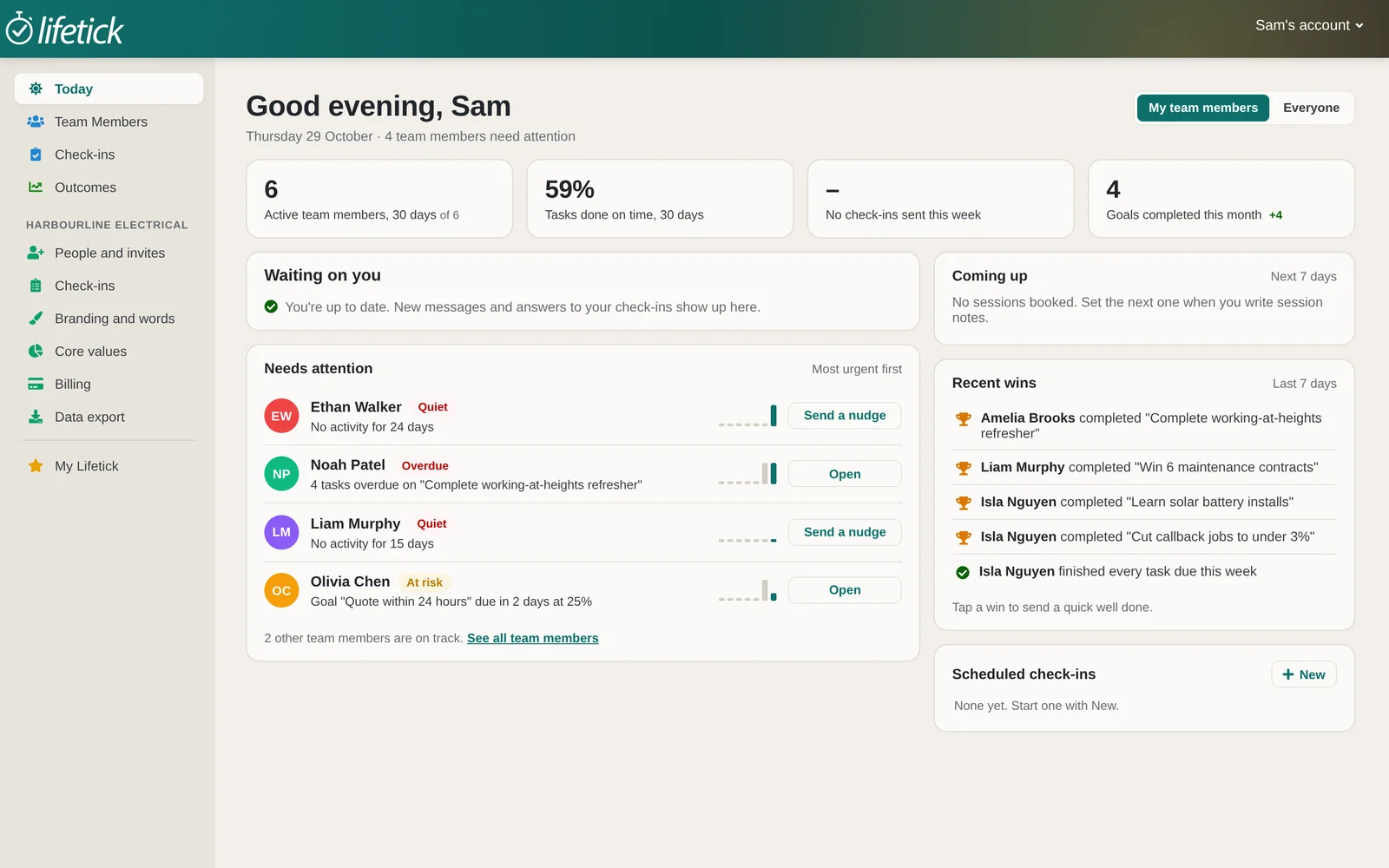
You see the whole team on one page: goals on track and finished, tasks done on time, and anyone who has gone quiet. A weekly check-in asks what got done on goals and what got in the way, and the answers sit beside the goals. See Set your core values and The team Outcomes report.
For how it all fits together, see Team goal tracking and goal setting software for small teams.

Twenty performance goals examples for staff and managers, each with a number, a date and a first step, so reviews talk about progress, not opinions.
For teamsTwenty professional development goals examples for skills, study, leadership and career moves, each with a date and a first step for this week.
For youTwenty-five personal goals examples for health, habits, relationships, learning and home, each with a number, a date and a first step for this week.
Each person writes their goal, links it to a value and gets a weekly check-in. Free for 14 days, no card needed.