Run three client meetings on your own by the end of the quarter
Doing it is the fastest way to learn it. Three gives you a first try, a better try and one that feels normal.
These professional development goals are for people who want to grow at work and managers who want to help them. Most development plans fail the same way: "get better at presenting" goes in a form in March and nobody looks at it again until the next review.
Each goal here has a date and a first step, and each is a SMART goal. Pick one or two, make them fit the role, and talk about them in your next one-on-one. Or shape your own with the SMART goal generator.
Skill goals are about getting better at something you already do. Tie each one to a piece of real work so the practice happens on the job.
4 examplesDoing it is the fastest way to learn it. Three gives you a first try, a better try and one that feels normal.
A useful report is practice with a reason. Each month's report can be a bit harder than the last.
Short talks to people you know are the easiest way to get comfortable presenting.
Small speed-ups in tools you use every day add up to hours a month.
Study goals need a weekly time slot or they lose to everything else. Plan the hours, not just the end date. See Fitting study goals around work.
4 examplesA finished course beats three started ones. Choose one that ends in something you can show.
Hours are fully in your control, even when the material is hard. Three hours is two short sessions and one longer one.
A qualification with a date gives the study a deadline and the result is something you keep.
Twelve books is a lot of new ideas. Keep a note of one thing to try from each.
Leadership goals work for people who manage now and for people who want to. Start small and measure something you actually did.
4 examplesTeaching someone else is the fastest way to find out what you know.
Running a meeting is a real leadership skill: keeping time, drawing people in and getting to a decision.
Feedback you ask for is easier to hear than feedback you get by surprise. Three people gives you a pattern.
A small project gives you the whole cycle: planning, people, problems and a finish line.
Good work only helps your career if people know about it. These goals make that part of the job.
4 examplesKnowing people across the business makes your job easier and opens doors you can't see yet.
A short note or a five-minute demo helps the team and shows what you're working on.
Events are where you hear what's changing in your field before it reaches your desk.
When review time comes, you'll have the examples ready instead of trying to remember.
Career goals are the bigger moves. Break them into steps you can take now, and talk about them openly with your manager.
4 examples"Ready" needs a definition. Ask what the role needs, then turn each gap into its own goal.
A day in another team tells you more than any job description.
A plan you both agreed is far more likely to get time and budget than one you keep to yourself.
A stretch task is just past what you can do now. One a quarter is enough to keep growing without burning out.
A skill you use on the job this month sticks better than one learned for later.
Put the time in your diary each week. A goal with no time slot loses to urgent work.
Development goals sit on top of the day job. Two is plenty.
Tell your manager. They can find you the meeting to run or the project to lead.
Every goal above ends with a first step. Do it before the week is out.
Check progress at every one-on-one so it doesn't wait for the yearly review. See One-on-one agenda.
They are goals for growing in your work: new skills, study, leadership or a career move. Unlike performance goals, which are about doing the current job well, development goals are about getting ready for what's next.
Start with where you want to be in a year or two, then ask what's missing to get there. Turn each gap into a goal with a date and a first step, and agree them with your manager so you get the time to work on them.
One or two at a time. They need time each week on top of the day job, so more than two usually means none of them move.
Yes, in most cases. Your manager can find you chances to practise and make time for study. If a goal is about leaving the role, it's fine to keep that one to yourself.
Talk about progress at each one-on-one meeting, and take a proper look each quarter. Change a goal if your plans change.
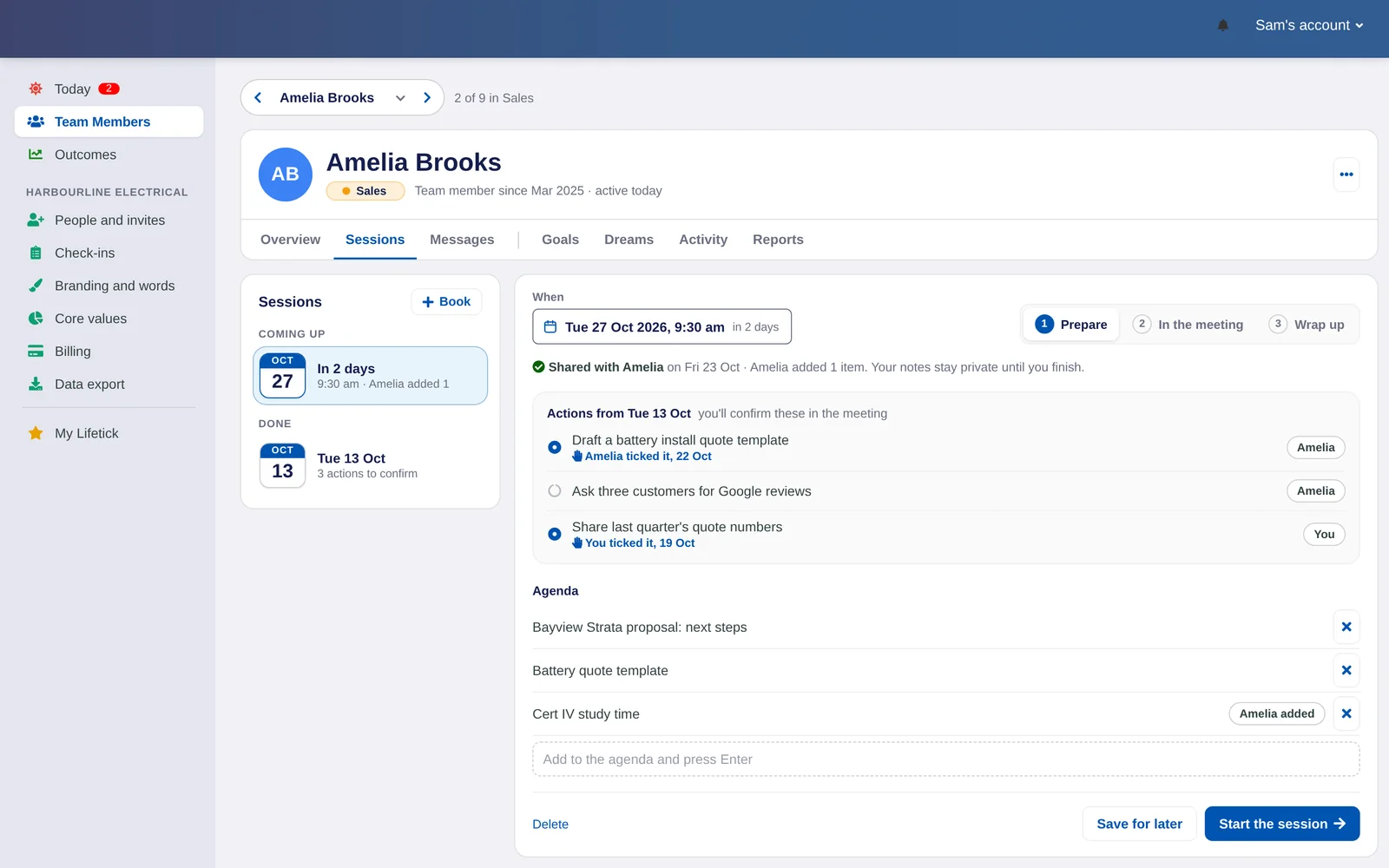
In Lifetick, you write development goals in your own words and break them into tasks with dates and reminders, like study sessions or the talk you're giving. You choose which goals your manager sees, so a goal can stay private.
One-on-ones keep the conversation going: you share an agenda before you meet, agree actions together, and anything not done carries over to the next one so it isn't lost. See Schedule a one-on-one and Carry actions to the next one.
For how it works across a team, see one-on-one meetings and goal setting software for small teams.

Twenty team goal examples for sales, support, operations and small business owners, each with a number, a date and a first step to take this week.
For teamsTwenty performance goals examples for staff and managers, each with a number, a date and a first step, so reviews talk about progress, not opinions.
For youTwenty-five personal goals examples for health, habits, relationships, learning and home, each with a number, a date and a first step for this week.
Each person writes their goal, links it to a value and gets a weekly check-in. Free for 14 days, no card needed.